
OUR BUILDING SYSTEM
Why Dovetail Log Building Construction?
Not all log homes are built the same. At Timber Crafted Homes, we build exclusively with the hewn dovetail system, a centuries-old method refined with modern precision to produce a stronger, tighter, and more beautiful structure than round-log construction.


A LITTLE HISTORY
The dovetail log system was brought to North America by Scandinavian and German settlers in the 1600s–1700s, craftspeople who had deep roots in log building from their European homelands. Over generations, their techniques merged with those of the Scotch-Irish settlers of the Appalachians, giving rise to what became known as the "Appalachian Dovetail": the gold standard of American log construction.
ROUND LOG vs. DOVETAIL
ROUND LOG HOMES
X Round logs only available with boxed heart
X Loose-fitting corners prone to air and water gaps
X Significant checking within 1-3 years
X More log movement during wood climitization
X Interior house construction challenges with uneven log surfaces
WHAT WE BUILD
DOVETAIL LOG HOMES -
Built to last generations
Self-locking dovetail corners that tighten under load
FOHC milling for maximum stability and minimal checking
Double gasket TG joint with no chinking required
Minimal settling by design
OUR TIMBER SPECIFICATION
Timber
Canadian Douglas Fir or White Spruce
8" x 12"
Standard log size
(width by height)
FOHC
Free of heart centre milling standard
WHITE SPRUCE
A stable, straight-grained species well suited to log construction. Sourced dry and seasoned so it arrives at the job site ready to build. This is our cost-effective wood option.
DOUGLAS FIR
One of the strongest structural softwoods available. Dense, durable, and naturally resistant to decay. A premium choice for a log home built to stand for generations.
WHY FREE OF HEART CENTER MATTERS
All our logs are sawn Free of Heart Centre (FOHC), meaning the unstable pith of the tree is removed entirely. This results in significantly less checking (cracking) compared to boxed-heart logs where the pith remains. FOHC timber is more dimensionally stable, holds its shape better as it dries, and produces a cleaner and more predictable log wall over the life of the building.
(Timber Crafted Homes)

Boxed Heart
Douglas Fir Wood

Free of Heart Center
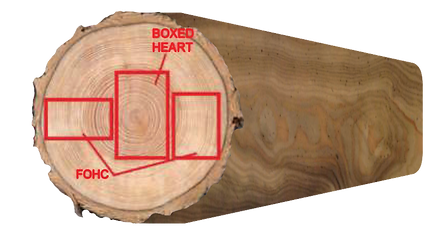
Douglas Fir Wood
WHAT MAKES DOVETAIL SUPERIOR
SELF-LOCKING JOINT
The dovetail notch draws tighter as upper logs add weight. The heavier the structure, the stronger the corners become.
SELF-DRAINING DESIGN
Each notch is angled to shed rainwater outward, protecting the joint from moisture penetration and long-term decay.
LOAD-BEARING CORNERS
While our horizontal T&G air sealing log design is structurally strong and stable, most weight is carried through the corner notches
NATURAL THERMAL MASS
Solid log walls store heat and release it slowly over 8 to 12 hours, keeping interiors comfortable without relying solely on insulation R-values.
TIMELESS CHARACTER
The visible corner notches are the defining aesthetic of Appalachian log architecture. Honest, handcrafted, and unmistakable.
HANDCRAFTED PRECISION
Every notch is laid out and cut by hand using traditional tools. Each one shaped with care for your specific structure.
HOW WE BUILD IT
Our system
1.
FOHC milling for minimal checking
All logs are Free of Heart Centre, removing the unstable pith before the timber ever reaches your wall. The result is a clean, stable log that checks far less than boxed-heart alternatives and looks better for decades to come.
3.
Double gasket sealing system
A double gasket runs through the TG joint and along the inside corner face of every dovetail notch. Where traditional dovetail homes relied on chinking to seal the gaps, our system is airtight from the moment it is assembled. No chinking required for performance.
5.
Hand-cut dovetail corner notches
Every corner notch is laid out with a framing square and cut by hand with traditional tools including mallet, chisel, slick, and hand saws. Preventive hollowing at key surfaces compensates for any future moisture movement.
2.
8" x 12" square log with twin T&G joint
Our standard log profile is 8 inches wide by 12 inches tall (nominal after processing), machined with a twin tongue-and-groove joint along its length. This T&G joint, combined with double gaskets, creates a fully airtight seal between every log course and eliminates the need for traditional chinking to achieve energy efficiency.
4.
Optional chink chamfer for the old-world look
A horizontal chamfer is machined into each log, creating a natural shadow line between courses. Customers who love the look of a traditional chinked cabin can apply chinking purely for aesthetics. The structural seal is already in place underneath.
6.
#1 grade resawn seasoned timber
We use air-dried white spruce and Douglas fir for stability. Starting dry means the logs have already done most of their shrinking before they are ever stacked, resulting in minimal settling once your home is built. (Inquire about kiln-dried timber)
CONTACT US WITH QUESTIONS
